Σάββατο 22 Δεκεμβρίου 2012
God's gender divides Germany "high'n'mighty"
A minister in Angela Merkel's government has sparked a pre-Christmas row among Germany's ruling parties by suggesting God be referred to with the neutral article "das" instead of the masculine "der", Reuters reports from Berlin.
Σάββατο 1 Δεκεμβρίου 2012
Pink for girls & Blue for Boys? (nurture vs nature)
Read a great article on this question at: When Did Girls Start Wearing Pink?
Little
Franklin Delano Roosevelt sits primly on a stool, his white skirt
spread smoothly over his lap, his hands clasping a hat trimmed with a
marabou feather. Shoulder-length hair and patent leather party shoes
complete the ensemble.
Read more: http://www.smithsonianmag.com/arts-culture/When-Did-Girls-Start-Wearing-Pink.html#ixzz2Dn28NWGz
Follow us: @SmithsonianMag on Twitter
Read more: http://www.smithsonianmag.com/arts-culture/When-Did-Girls-Start-Wearing-Pink.html#ixzz2Dn28NWGz
Follow us: @SmithsonianMag on Twitter
Little
Franklin Delano Roosevelt sits primly on a stool, his white skirt
spread smoothly over his lap, his hands clasping a hat trimmed with a
marabou feather. Shoulder-length hair and patent leather party shoes
complete the ensemble.
Read more: http://www.smithsonianmag.com/arts-culture/When-Did-Girls-Start-Wearing-Pink.html#ixzz2Dn28NWGz
Follow us: @SmithsonianMag on Twitter
Read more: http://www.smithsonianmag.com/arts-culture/When-Did-Girls-Start-Wearing-Pink.html#ixzz2Dn28NWGz
Follow us: @SmithsonianMag on Twitter
Little
Franklin Delano Roosevelt sits primly on a stool, his white skirt
spread smoothly over his lap, his hands clasping a hat trimmed with a
marabou feather. Shoulder-length hair and patent leather party shoes
complete the ensemble.
We find the look unsettling today, yet social convention of 1884, when FDR was photographed at age 2 1/2, dictated that boys wore dresses until age 6 or 7, also the time of their first haircut. Franklin’s outfit was considered gender-neutral.
But nowadays people just have to know the sex of a baby or young child at first glance, says Jo B. Paoletti, a historian at the University of Maryland and author of Pink and Blue: Telling the Girls From the Boys in America, to be published later this year. Thus we see, for example, a pink headband encircling the bald head of an infant girl.
Why have young children’s clothing styles changed so dramatically? How did we end up with two “teams”—boys in blue and girls in pink?
“It’s really a story of what happened to neutral clothing,” says Paoletti, who has explored the meaning of children’s clothing for 30 years. For centuries, she says, children wore dainty white dresses up to age 6. “What was once a matter of practicality—you dress your baby in white dresses and diapers; white cotton can be bleached—became a matter of ‘Oh my God, if I dress my baby in the wrong thing, they’ll grow up perverted,’ ” Paoletti says.
The march toward gender-specific clothes was neither linear nor rapid. Pink and blue arrived, along with other pastels, as colors for babies in the mid-19th century, yet the two colors were not promoted as gender signifiers until just before World War I—and even then, it took time for popular culture to sort things out.
For example, a June 1918 article from the trade publication Earnshaw's Infants' Department said, “The generally accepted rule is pink for the boys, and blue for the girls. The reason is that pink, being a more decided and stronger color, is more suitable for the boy, while blue, which is more delicate and dainty, is prettier for the girl.” Other sources said blue was flattering for blonds, pink for brunettes; or blue was for blue-eyed babies, pink for brown-eyed babies, according to Paoletti.
In 1927, Time magazine printed a chart showing sex-appropriate colors for girls and boys according to leading U.S. stores. In Boston, Filene’s told parents to dress boys in pink. So did Best & Co. in New York City, Halle’s in Cleveland and Marshall Field in Chicago.
Today’s color dictate wasn’t established until the 1940s, as a result of Americans’ preferences as interpreted by manufacturers and retailers. “It could have gone the other way,” Paoletti says.
So the baby boomers were raised in gender-specific clothing. Boys dressed like their fathers, girls like their mothers. Girls had to wear dresses to school, though unadorned styles and tomboy play clothes were acceptable.
Read more: http://www.smithsonianmag.com/arts-culture/When-Did-Girls-Start-Wearing-Pink.html#ixzz2DmznCtVe
Follow us: @SmithsonianMag on Twitter
We find the look unsettling today, yet social convention of 1884, when FDR was photographed at age 2 1/2, dictated that boys wore dresses until age 6 or 7, also the time of their first haircut. Franklin’s outfit was considered gender-neutral.
But nowadays people just have to know the sex of a baby or young child at first glance, says Jo B. Paoletti, a historian at the University of Maryland and author of Pink and Blue: Telling the Girls From the Boys in America, to be published later this year. Thus we see, for example, a pink headband encircling the bald head of an infant girl.
Why have young children’s clothing styles changed so dramatically? How did we end up with two “teams”—boys in blue and girls in pink?
“It’s really a story of what happened to neutral clothing,” says Paoletti, who has explored the meaning of children’s clothing for 30 years. For centuries, she says, children wore dainty white dresses up to age 6. “What was once a matter of practicality—you dress your baby in white dresses and diapers; white cotton can be bleached—became a matter of ‘Oh my God, if I dress my baby in the wrong thing, they’ll grow up perverted,’ ” Paoletti says.
The march toward gender-specific clothes was neither linear nor rapid. Pink and blue arrived, along with other pastels, as colors for babies in the mid-19th century, yet the two colors were not promoted as gender signifiers until just before World War I—and even then, it took time for popular culture to sort things out.
For example, a June 1918 article from the trade publication Earnshaw's Infants' Department said, “The generally accepted rule is pink for the boys, and blue for the girls. The reason is that pink, being a more decided and stronger color, is more suitable for the boy, while blue, which is more delicate and dainty, is prettier for the girl.” Other sources said blue was flattering for blonds, pink for brunettes; or blue was for blue-eyed babies, pink for brown-eyed babies, according to Paoletti.
In 1927, Time magazine printed a chart showing sex-appropriate colors for girls and boys according to leading U.S. stores. In Boston, Filene’s told parents to dress boys in pink. So did Best & Co. in New York City, Halle’s in Cleveland and Marshall Field in Chicago.
Today’s color dictate wasn’t established until the 1940s, as a result of Americans’ preferences as interpreted by manufacturers and retailers. “It could have gone the other way,” Paoletti says.
So the baby boomers were raised in gender-specific clothing. Boys dressed like their fathers, girls like their mothers. Girls had to wear dresses to school, though unadorned styles and tomboy play clothes were acceptable.
Read more: http://www.smithsonianmag.com/arts-culture/When-Did-Girls-Start-Wearing-Pink.html#ixzz2DmznCtVe
Follow us: @SmithsonianMag on Twitter
Little
Franklin Delano Roosevelt sits primly on a stool, his white skirt
spread smoothly over his lap, his hands clasping a hat trimmed with a
marabou feather. Shoulder-length hair and patent leather party shoes
complete the ensemble.
We find the look unsettling today, yet social convention of 1884, when FDR was photographed at age 2 1/2, dictated that boys wore dresses until age 6 or 7, also the time of their first haircut. Franklin’s outfit was considered gender-neutral.
But nowadays people just have to know the sex of a baby or young child at first glance, says Jo B. Paoletti, a historian at the University of Maryland and author of Pink and Blue: Telling the Girls From the Boys in America, to be published later this year. Thus we see, for example, a pink headband encircling the bald head of an infant girl.
Why have young children’s clothing styles changed so dramatically? How did we end up with two “teams”—boys in blue and girls in pink?
“It’s really a story of what happened to neutral clothing,” says Paoletti, who has explored the meaning of children’s clothing for 30 years. For centuries, she says, children wore dainty white dresses up to age 6. “What was once a matter of practicality—you dress your baby in white dresses and diapers; white cotton can be bleached—became a matter of ‘Oh my God, if I dress my baby in the wrong thing, they’ll grow up perverted,’ ” Paoletti says.
The march toward gender-specific clothes was neither linear nor rapid. Pink and blue arrived, along with other pastels, as colors for babies in the mid-19th century, yet the two colors were not promoted as gender signifiers until just before World War I—and even then, it took time for popular culture to sort things out.
For example, a June 1918 article from the trade publication Earnshaw's Infants' Department said, “The generally accepted rule is pink for the boys, and blue for the girls. The reason is that pink, being a more decided and stronger color, is more suitable for the boy, while blue, which is more delicate and dainty, is prettier for the girl.” Other sources said blue was flattering for blonds, pink for brunettes; or blue was for blue-eyed babies, pink for brown-eyed babies, according to Paoletti.
In 1927, Time magazine printed a chart showing sex-appropriate colors for girls and boys according to leading U.S. stores. In Boston, Filene’s told parents to dress boys in pink. So did Best & Co. in New York City, Halle’s in Cleveland and Marshall Field in Chicago.
Today’s color dictate wasn’t established until the 1940s, as a result of Americans’ preferences as interpreted by manufacturers and retailers. “It could have gone the other way,” Paoletti says.
So the baby boomers were raised in gender-specific clothing. Boys dressed like their fathers, girls like their mothers. Girls had to wear dresses to school, though unadorned styles and tomboy play clothes were acceptable.
Read more: http://www.smithsonianmag.com/arts-culture/When-Did-Girls-Start-Wearing-Pink.html#ixzz2DmznCtVe
Follow us: @SmithsonianMag on Twitter
We find the look unsettling today, yet social convention of 1884, when FDR was photographed at age 2 1/2, dictated that boys wore dresses until age 6 or 7, also the time of their first haircut. Franklin’s outfit was considered gender-neutral.
But nowadays people just have to know the sex of a baby or young child at first glance, says Jo B. Paoletti, a historian at the University of Maryland and author of Pink and Blue: Telling the Girls From the Boys in America, to be published later this year. Thus we see, for example, a pink headband encircling the bald head of an infant girl.
Why have young children’s clothing styles changed so dramatically? How did we end up with two “teams”—boys in blue and girls in pink?
“It’s really a story of what happened to neutral clothing,” says Paoletti, who has explored the meaning of children’s clothing for 30 years. For centuries, she says, children wore dainty white dresses up to age 6. “What was once a matter of practicality—you dress your baby in white dresses and diapers; white cotton can be bleached—became a matter of ‘Oh my God, if I dress my baby in the wrong thing, they’ll grow up perverted,’ ” Paoletti says.
The march toward gender-specific clothes was neither linear nor rapid. Pink and blue arrived, along with other pastels, as colors for babies in the mid-19th century, yet the two colors were not promoted as gender signifiers until just before World War I—and even then, it took time for popular culture to sort things out.
For example, a June 1918 article from the trade publication Earnshaw's Infants' Department said, “The generally accepted rule is pink for the boys, and blue for the girls. The reason is that pink, being a more decided and stronger color, is more suitable for the boy, while blue, which is more delicate and dainty, is prettier for the girl.” Other sources said blue was flattering for blonds, pink for brunettes; or blue was for blue-eyed babies, pink for brown-eyed babies, according to Paoletti.
In 1927, Time magazine printed a chart showing sex-appropriate colors for girls and boys according to leading U.S. stores. In Boston, Filene’s told parents to dress boys in pink. So did Best & Co. in New York City, Halle’s in Cleveland and Marshall Field in Chicago.
Today’s color dictate wasn’t established until the 1940s, as a result of Americans’ preferences as interpreted by manufacturers and retailers. “It could have gone the other way,” Paoletti says.
So the baby boomers were raised in gender-specific clothing. Boys dressed like their fathers, girls like their mothers. Girls had to wear dresses to school, though unadorned styles and tomboy play clothes were acceptable.
Read more: http://www.smithsonianmag.com/arts-culture/When-Did-Girls-Start-Wearing-Pink.html#ixzz2DmznCtVe
Follow us: @SmithsonianMag on Twitter
Παρασκευή 23 Νοεμβρίου 2012
Πέμπτη 8 Νοεμβρίου 2012
Your "Pro-Slut" Problem—Not Ours, by Sigal Samuel
“Sigal Samuel seems to be pro-slut,” wrote Yisrael Medad after I published a column
in support of Sarit Hashkes, the Israeli activist who decided to take
off her shirt rather than yield to ultra-Orthodox attempts to drive her
away from a public party.
For
a moment, I stared at the word “slut” in mute shock. How could anyone
fail to understand that to call Hashkes a slut now would be to
reinscribe the very premise that had occasioned her actions in the first
place? Then the moment passed, and I realized Medad’s comment—later
elaborated on in The Jerusalem Post and on his personal blog—wasn’t
really that surprising after all. In fact, it was typical of the
responses feminists incur when they attempt to reappropriate a word,
image or meme that’s being used against them.
Δευτέρα 29 Οκτωβρίου 2012
Αραβική άνοιξη: πώς οι γυναίκες χρησιμοποιούν το σώμα τους για να κάνουν επανάσταση
των Nadia Leila Aissaoui και Ziad Majed, μετάφραση: Λίνα Φιλοπούλου
Στις συντηρητικές κοινωνίες οι άνδρες πάντα είχαν υποταγμένες τις γυναίκες ασκώντας έλεγχο πάνω στο σώμα τους. Το γυναικείο σώμα, παρθένο και γονιμοποιήσιμο, αλυσοδεμένο, καλυμμένο και κρυμμένο, είναι το αντικείμενο κάθε είδους απαγορεύσεων και εμμονών. Είναι εξίσου πολυπόθητο ως σύμβολο της οικογενειακής τιμής και στιγματισμένο ως πηγή πειρασμού και διχόνοιας – η λέξη στα αραβικά είναι fitna.Θέλοντας να προκαλέσουν αυτή την εμμονή, οι γυναίκες σε πολλές αραβικές χώρες δείχνουν αποφασισμένες να ανατρέψουν το κατεστημένο θέτοντας το ζήτημα του σώματός τους στο επίκεντρο της δημόσιας συζήτησης. Θέλουν να αποδείξουν σε μια πατριαρχική κοινωνία ότι η επανάσταση πραγματικά χάνει – και ότι δε θα συμβεί χωρίς τις ίδιες.
Ανυπακοή ενάντια στη σεξουαλική παρενόχληση στην Αίγυπτο
Όλα ξεκίνησαν στην Αίγυπτο όταν ξέσπασε το σκάνδαλο σχετικά με τα τεστ παρθενίας, στα οποία αναγκάστηκαν να υποβληθούν γυναίκες διαδηλώτριες υπό στρατιωτική κράτηση. Η πρακτική αυτή, μέχρι σήμερα άγνωστη και αποσιωποιημένη από πολλές γυναίκες από φόβο μήπως στιγματιστούν από τις οικογένειές τους και από την κοινωνία, καταγγέλθηκε από μια γυναίκα με το όνομα Samira Ιbrahim ως μια εσκεμμένη προσπάθεια του στρατού να εξευτελίσει τις γυναίκες διαδηλώτριες. Η Samira Ιbrahim έσυρε τον αιγυπτιακό στρατό στα δικαστήρια και κέρδισε όταν το διοικητικό δικαστήριο στο Κάιρο έκρινε αυτά τα τεστ παράνομα.

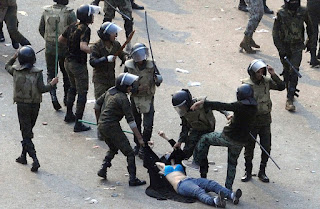
Σε μια άλλη ταπεινωτική πράξη, αυτή τη φορά σε πλήρη θέα των φωτογραφικών φακών (βλ. παρακάτω), μία γυναίκα διαδηλώτρια σύρθηκε στο δρόμο στην Αίγυπτο, ξυλοκοπήθηκε και ποδοπατήθηκε από την αστυνομία, της έσκισαν τα ρούχα της, αποκαλύπτοντας από κάτω ένα μπλε σουτιέν.
Το περιστατικό προκάλε τη δημόσια κατακραυγή και μια έξαρση πολιτικών, πολιτιστικών και καλλιτεχνικών (αφίσες και γκραφίτι) αντιδράσεων.

του Yasser Abou Hamed
Αυτή η βία εξέφρασε την αποφασιστικότητα, με την οποία ήθελαν να
περιορίσουν τα κοινωνικά και πολιτικά δικαιωμάτα των γυναικών. Το να
τους βγάζουν τα ρούχα ήταν μια πράξη που στόχευε ειδικά στον εξευτελισμό
τους, καθώς και Πέμπτη 18 Οκτωβρίου 2012
Φουκώ: Friendship as a way of life..
Friendship as a Way of Life / Michel Foucault
R. de Ceccaty, J. Danet, and J. Le Bitoux interviewed Foucault for the French magazine Gai Pied - it appeared inApril 1981.(Translation by John Johnston.)
M.F. That the magazine exists is the positive and important thing. In answer to your question, I could say that I don’t have to read it to voice the question of my age. What I could ask of your magazine is that I do not, in reading it, have to pose the question of my age. Now, reading it…
Εγγραφή σε:
Αναρτήσεις (Atom)